An app, a service, or a system
Software@BuildableWorks/software
Frames for architecture, audience, criteria, and market, and specs grouped by domain.
- Frames
- Specs
Free for macOS, Windows, and Linux
Eidos keeps every part of what you make as a plain file, shaped by a framework for your kind of work. A canvas, a backlog, a decision log, comments, and your own AI agent all point at those same files, in a folder you own.
Made foran appa novel seriesa worlda gamea channela coursea businessa renovation
No account. No subscription. Your files stay yours.
app downloadsnpm downloads last week


How it works
Write it down once, and everyone, every agent included, reads the same thing. Every move leaves a plain file in a folder you own.
Pick the framework closest to what you make, from the Registry or right in the app. It sets the collections (chapters, specs, rooms, videos), their templates, and the properties each file carries, and you reshape it whenever it stops fitting.
A character, a feature, a room, an episode: each is one markdown file with a permanent id, saying what that part is and why. The health check tells you which ones are missing a section or a property.
Draw it on the canvas, plan it on the board, record what was decided, discuss it, and ask your agent about it. Every one of those points back at the same file, so nothing becomes a second copy of the truth.
Core plugins
A canvas, a backlog, a decision log, comments, git, and your own AI agent, built into one free app. Each one points at the blueprint it serves, and switching one off leaves your files exactly as they were.
Claude Code, Codex, or any agent that speaks the Agent Client Protocol, beside every page, with what you have open as context. Grill a draft with /grill, file work with /task, log a call with /decide, and add slash commands of your own for the whole team.
Explore AI Agent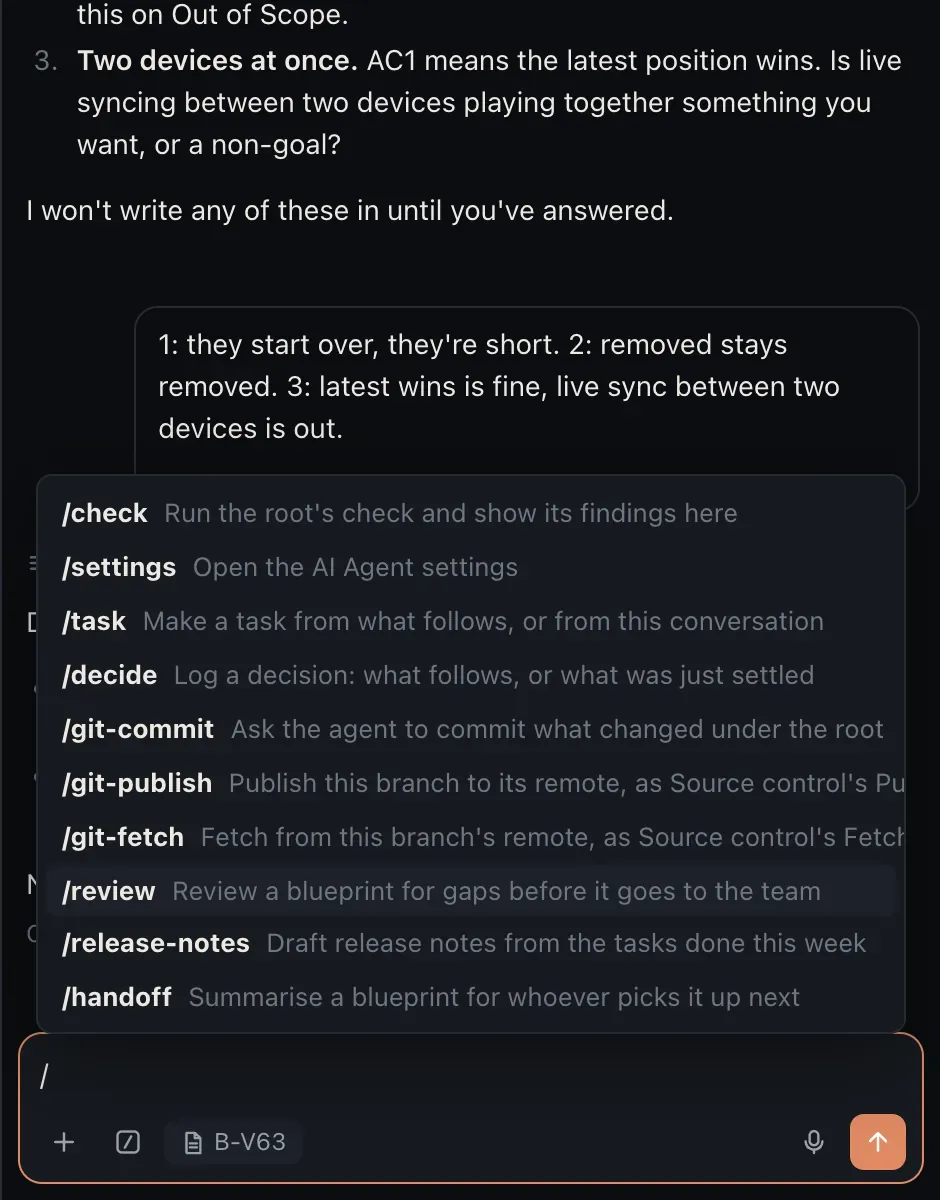
A real board, made of markdown: task types, subtasks, links, checklists, and statuses you define. Every task serves a blueprint by its id, and closes when the work ships while the blueprint stays.
Explore Backlog
Blueprints drawn live from their files, frames and labelled flows between them, sticky notes, and sketches you promote into real blueprints when they are ready.
Explore Canvas
Your agent logs what it decided as itself. A decision waits in an inbox until a person confirms it, then shows in the blueprint it was made for, with who confirmed it and when.
Explore Decisions
Threads anchored to a section, with reactions and @mentions, signed by people and agents, and written into the file so every reader and every diff sees them.
Explore Comments
File history and a diff viewer for every blueprint, commit and publish in a click, and auto save with commit messages your agent writes.
Explore Git
Frameworks
A framework is the shape of your files: the collections, their templates, and the properties each one carries. These are published in the Registry today, for very different work. Install one whole, take a single collection from it, or shape and publish your own.
An app, a service, or a system
Frames for architecture, audience, criteria, and market, and specs grouped by domain.
A book, a long argument, or a course
Frames for premise, reader, voice, and market, and chapters grouped by part.
A fictional world, for a series or a table
Places by region, factions, characters, arcs by campaign, a history, and a player role that sees only what is revealed.
A video game, a mechanic at a time
Mechanics and items by system, levels by act, characters and enemies, a cut list, a playtest log, and a playtester role that sees only what is in the build.
A video channel, a podcast, or a stream
Videos and posts by series, pages, a content calendar, a brand kit, and a rate card.
A school of courses
Learner personas, courses by track, learning paths, and a catalog.
A business as it develops
The thesis, the market, the money, and the runway; ideas, plans, and investments by line; and the decisions made.
A question, a study, or a programme
Frames for question, prior work, method, and ethics, and investigations grouped by strand.
A house, room by room
Rooms by floor, the work by phase, selections by room, a schedule, and a change log.
A wedding, as its run of show
The big picture, moments by day, vendors by category, and the timeline.
An Obsidian vault in the ACE shape
Atlas, Calendar, and Efforts, with an Eidos framework under the vault.
Eidos for…
Each one starts from your problem, shows the framework to install, and the plugins that matter most for your work.
Where Eidos fits
Each of those does its own job well. None of them keeps a checked definition of what you make, in your own files, that outlives the work. Eidos does that one thing, and works alongside the rest.
The definition, kept true.
Other apps have a canvas, a board, or an agent panel, and a few have all three. What Eidos adds is underneath: every unit is a markdown file checked against a framework you declare, served by a backlog and a decision log a person confirms, with frameworks you can share through a Registry, in one free, local app.
Human-first
A definition is a check on the work, and a check only works if it comes from somewhere else. Let an agent write the definition and then the work, and everything agrees while nobody decided anything.
So the intent, the scope, and the decisions stay with a person. Your agent reads the files, asks where you were vague, presses hardest on what is out of scope, and logs its own calls for you to confirm. Eidos itself never writes a sentence of a blueprint, and the agent only works when you ask it to.
A blueprint nobody thought through is worse than none.
Help me tighten the Out of Scope before Tomás starts on it.
Before I add anything, three questions, because each one changes what the spec promises:
I won’t write any of these in until you’ve answered.
Free, local, yours
No account, no subscription, no trial that runs out.
The desktop app and the CLI are free for personal and commercial work, and nothing in them is a trial.
Blueprints are plain markdown in your repo, written to EIDOS.md, an open standard under Apache-2.0. Eidos MD is what sits on top, and your files never depend on it.
Eidos has no AI service of its own. The agent is the one you already run, under its own permissions, and your files stay on your machine.
The CLI installs in seconds and answers in tenths of one, so an agent can lean on it all session.
εἶδος eidos, from the Greek: the form or essence of a thing.
Download Eidos MD, open a folder, and start from the framework closest to your work. Everything it gives you can be reshaped later.
macOS (Apple Silicon and Intel) · Windows 10 and 11 · Linux (AppImage and deb)
npm install -g eidosmd