Your own agent, with the page as context.
Claude Code, Codex, or any agent that speaks the Agent Client Protocol, beside every page in Eidos, with your team’s own slash commands. No Eidos model, no key, no account: it is the agent you already run, under its own permissions.
Free for macOS, Windows, and Linux. No account, no subscription.

Context
It sees what you see
Whatever you have open rides along with each message: a blueprint, a task, a canvas page, a collection and its filter. Type @ to pull in any blueprint, task, decision, or asset by its id, and the ids in a reply become links you can hover to read.
- The open page attached as a chip you can turn off
- @ references to blueprints, tasks, decisions, and assets
- Drag a tab onto the composer to attach it

Slash commands
Commands for the work, including your own
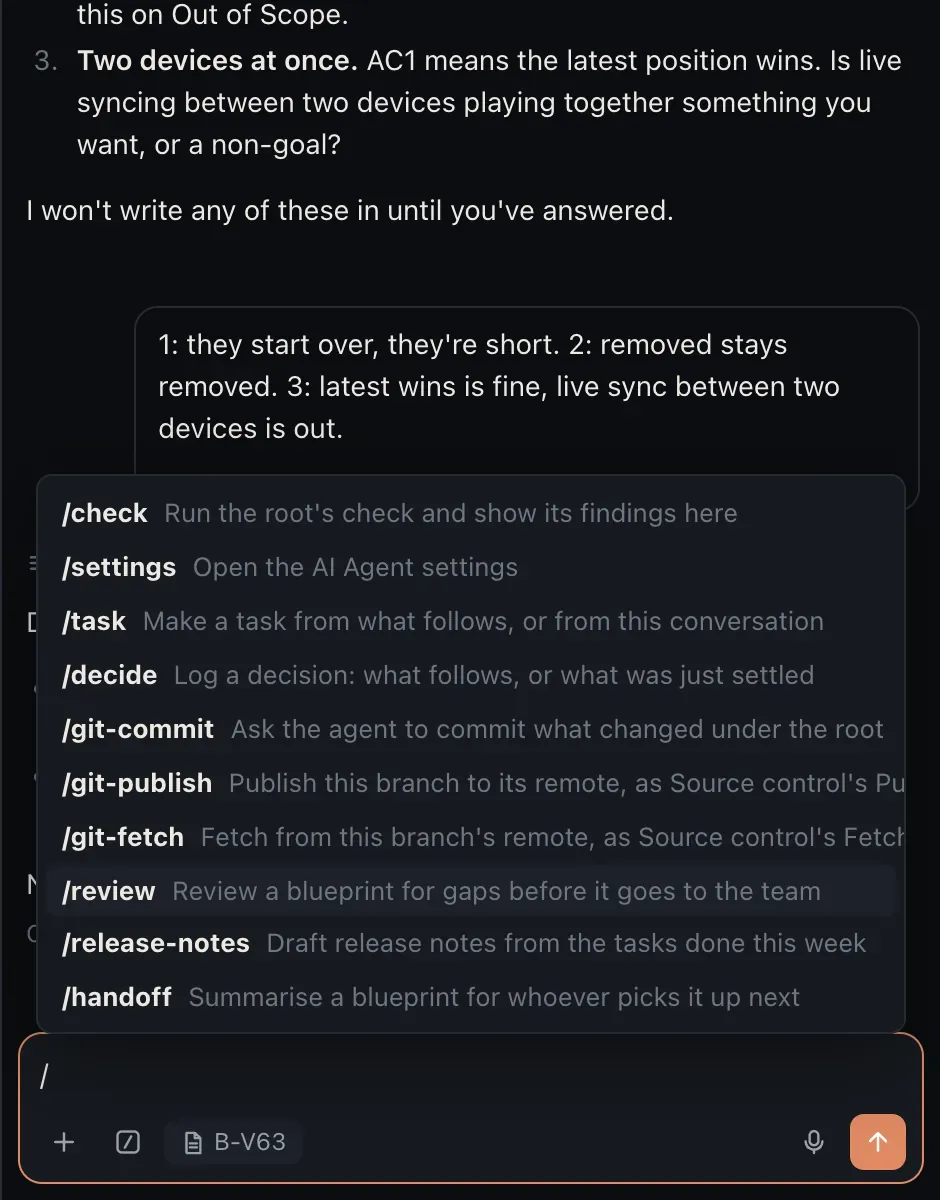
Built-in commands run the conversation (/grill, /explain, /check), plugins add commands for the work (/task, /decide, /git-commit), and your team adds its own: a name, a line that says what it does, and a prompt with $ARGUMENTS, shared with everyone in the root or kept on your machine.
- Custom commands shared with the root, or local
- Plugin commands appear when the plugin is on
- Made on the plugin’s page or from a terminal
Bring the agent you already pay for
Pick Claude Code or Codex on the plugin’s page, or point it at any command that speaks the Agent Client Protocol. A connection test tells you when it is found, started, signed in, and answering, and one click lets Claude Code run eidos commands without asking each time.
Grilled, not ghost-written
/grill turns the agent into an interviewer. It reads the open blueprint and asks one question at a time about what the text leaves unsaid, in the words of your role. When you are done, What did we find? lists each gap, your answer, and where it belongs, and offers to write it in.
Talk to it
Press ⇧⌘D and talk loosely. Whisper writes it down on your machine after a one-time model download, Tidy with AI can clean it up with your agent’s fastest model, and Use literal puts your exact words back.
Several conversations, shared with the team
Up to four agents work at once, each conversation marked working, waiting for you, or done, with a notification when one needs you. Save a conversation with the root, and a teammate opens it and carries on.
How it connects
The agent works through every other plugin.
Each plugin it touches leaves a record a person can read, and anything it decides on its own waits for a person.
- Blueprints
/checkruns the health check into the chat, and/migrateappears when the root is behind the standard. - Backlog
/taskmakes a task from the conversation, and Check for duplicates with AI asks whether a new task repeats an old one. - Decisions
/decidelogs a call. What the agent decides on its own it logs as itself, unconfirmed, for a person to confirm. - Git
/git-commitcommits what changed in the style of your recent commits, and Summarize asks it for a one-line message. - Comments
It replies in a thread signed as the agent, never as you.
- Assets
@offers images and files beside blueprints and tasks, with thumbnails.
From the shell
Your commands, from a terminal
Add a command for the whole team, then list every command the composer offers and where each one comes from.
$ eidos agent configure:command add review --prompt "Review $ARGUMENTS for gaps"
  /review  Review $ARGUMENTS for gaps
$ eidos agent commands
/grill  ·  Chat view
/task  ·  backlog plugin
/decide  ·  decisions plugin
/git-commit  ·  git plugin
/review · Custom shared · Review $ARGUMENTS for gapsWrite down what you’re making.
Download Eidos MD, open a folder, and start from the framework closest to your work. Everything it gives you can be reshaped later.
Free for macOS, Windows, and Linux. Your files stay plain text in a folder you own.