Git, for people who never open a terminal.
See what changed in any blueprint and who changed it, then commit and publish in a click. It is the git repository you already have: no Eidos server and no copy of your files, so a developer reviews the same commits in the same pull request as the code.
Free for macOS, Windows, and Linux. No account, no subscription.

History
Every blueprint remembers
File history sits beside the open blueprint: every commit that touched it, newest first, with who made it and when, following the file through renames. Diff opens that version against the file now, side by side or inline, with the changed words marked and the unchanged lines folded away.
- Follows a blueprint through renames
- Side by side or inline, changed words marked
- Or open diffs in your own tool, such as
code --diff

Auto save
Write all afternoon, committed as you go
Turn on Auto save for your machine and every change under the root is committed every 5, 15, 30, or 60 minutes, with your agent’s summary as the message, and pushed too if you switch on Publish. Auto fetch keeps the count of commits to pull current, so you know before you start when a teammate has been in.
- Your setting alone, never turned on for a teammate by a clone
- Never pushes over commits you have not pulled
- A file list as the message when no agent answers

From the chat
Ask your agent to commit
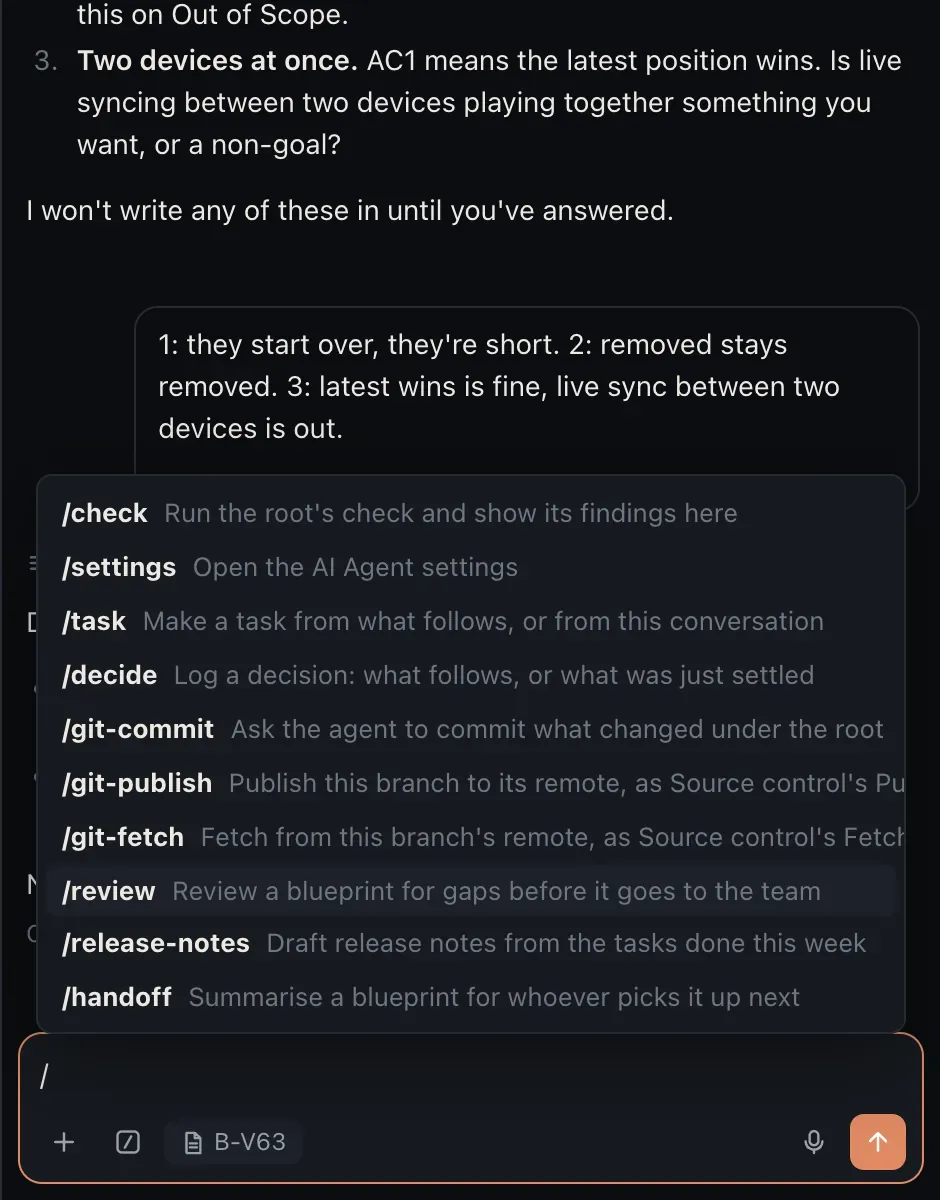
With the AI Agent on, /git-commit has your agent commit what changed in the style of your recent commits and tell you what it committed; anything you type after the command steers it. /git-publish and /git-fetch run Publish and Fetch straight away, without the agent, and say what happened in the conversation.
Versions
Name the version of what you shipped
Record a version names a commit (1.0, Beta, Book one) and can tag it, so “the spec as we shipped it” has a name everyone can find. The page shows each version with its commit, date, and tag, and says so when a tag has moved or gone missing, with a button for each fix.

Source control
Commit, fetch, pull, and publish
Source control lists what changed under the root, each file ticked. Write a line and Commit, and only the ticked files go in. Fetch counts the commits waiting on the remote, Pull brings them in, and Publish pushes yours, with the number the remote has not seen on the button.
- Summarize asks your AI Agent for the message
- Discard a change from its row, with a question first
- Git’s refusals shown as git said them
Renames and deletes that keep their history
Rename or delete a file from the page or with eidos, and it is a git mv or a git rm, so the history follows the file and nothing is lost that git cannot give back.
How it connects
One repository holds all of it.
Blueprints, tasks, decisions, canvases, threads, and files are plain files, so one commit carries a change and everything it touched.
- AI Agent
Summarize and auto save ask your agent for the message, and
/git-commitlets it commit for you. - Comments
A comment from someone not acting as a listed user is signed with their git identity.
- Backlog
Tasks are markdown files, committed and reviewed with the blueprints they serve.
- Assets
Renaming an asset is a
git mv, and an image swept away for having no link can be brought back from history. - Blueprints
The health check warns when a recorded version and the repository’s tags disagree.
From the shell
Versions, from a terminal
There is no eidos git: the repository is read with git itself. What Eidos adds is the version record and its tag.
$ eidos version record 1.0 --commit 7636e6e --tag
✓ 1.0 → 7636e6edb20e  tagged blueprints/1.0
$ eidos version
1.1  3a012df73c67  2026-10-07  blueprints/1.1
1.0  7636e6edb20e  2026-10-07  blueprints/1.0
$ git log --oneline --follow -- specs/playback/resume-playback.md
c21fb91 Show the resume flow in the spec
3a012df Attach the profile picker and TV sign-in code, add watchlist edge cases, stamp dates on save
0c6d6c3 Attach the resume flow and the TV prompt
…Write down what you’re making.
Download Eidos MD, open a folder, and start from the framework closest to your work. Everything it gives you can be reshaped later.
Free for macOS, Windows, and Linux. Your files stay plain text in a folder you own.